
Dillon County Projected Release Dates
SCDC calls its field PROJECTED RELEASE DATE. It is the date the agency projects that all incarcerated terms will be satisfied if the person keeps earning work, education, and good-conduct credits at the current rate. That makes it a live administrative forecast. It is not the actual discharge date and does not certify that the person left prison.
Three nearby fields answer different questions. Projected parole eligibility estimates when a legally eligible prisoner may first reach parole consideration. Supervised-reentry eligibility concerns a distinct transition route. The projected release date concerns satisfaction of incarcerated terms under the current calculation. None is the physical release timestamp.
| Date or status | Meaning | Best source |
|---|---|---|
| Projected release date | Current forecast for satisfying incarcerated terms | SCDC detail for a state prisoner |
| Parole eligibility | Potential point for board consideration | SCDC field and SCDPPPS board record |
| Local sentence estimate | Detention computation using the order and local credit | Dillon detention center |
| Actual release | Completed custody movement, release, or transfer | Released list or final booking/movement record |
Lookup Dillon County Release Dates
Begin with the custody system. The SCDC public application covers people currently sentenced to and incarcerated in the state prison system. Its data are current through midnight of the prior day. It excludes county detainees and released SCDC inmates. A Dillon County Detention Center sentence therefore cannot be calculated from the state detail unless the person was committed and transferred into SCDC custody.
- Identify whether the person is pretrial, serving a local Dillon sentence, or serving an SCDC term.
- For SCDC custody, search by SCDC number when possible, open the detail, and record the projected field with the page’s data date.
- Compare sentence and offense data, admission, committing county, and identity fields to avoid a same-name error.
- For a Dillon local term, obtain the sentencing order, jail-time credit, and detention center’s current computation.
- After the date passes, use the SCDC Released Inmate List or the Dillon final release record to confirm what occurred.
A missing current SCDC result does not prove release. The person may remain in Dillon County custody, have transferred to another system, or be outside the current search’s population. For a former state prisoner, start with the SCDC Released Inmate List. If the date is disputed or outside the searchable range, request the public movement and release record.
The state search shown in the official SCDC application places the projected field beside other sentence and custody data.
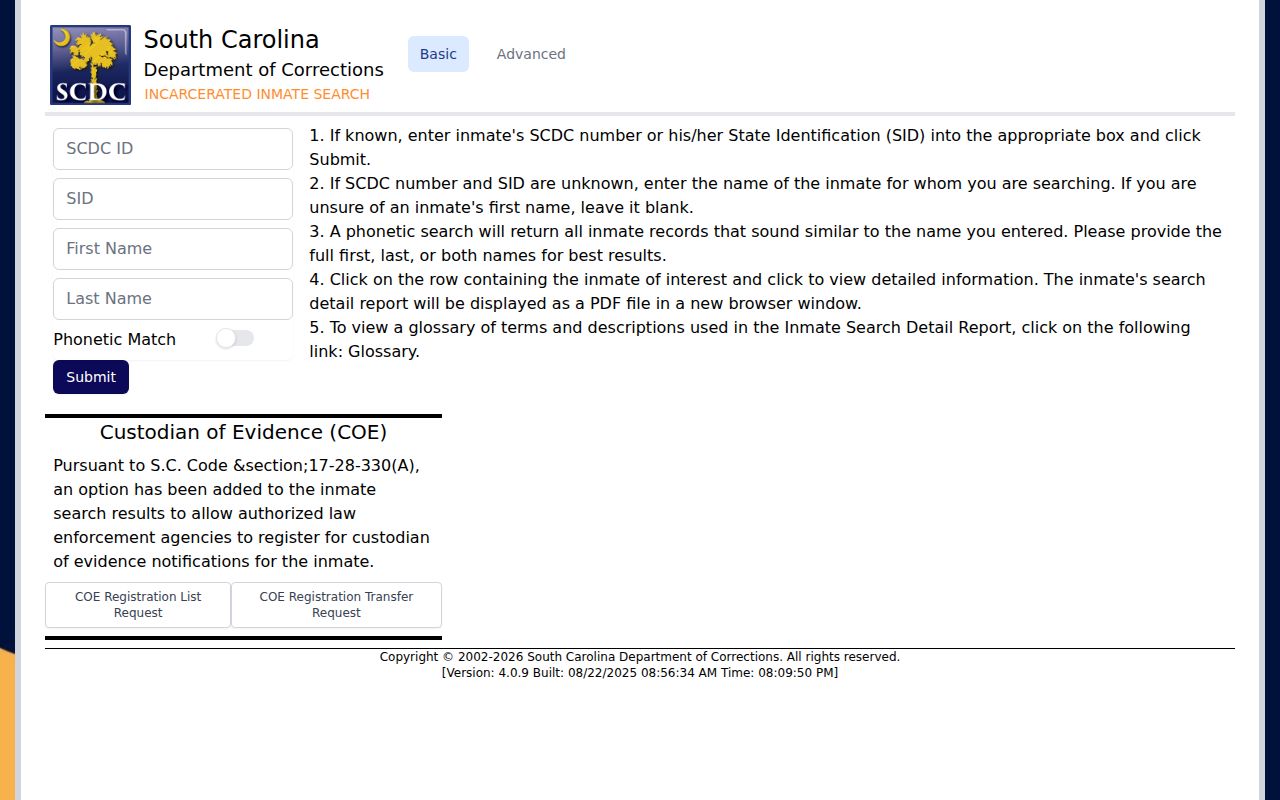
The displayed date must be read with the record’s update time and current custody status. It should never be copied as an actual Dillon County discharge date.
Dillon County Pretrial Release Timing
A pretrial detainee generally has no sentence-based projected release date. Release may depend on posting bond, a recognizance order, dismissal, a later hearing, or resolution of another hold. A bond order authorizes release on stated terms, but it does not prove that booking-out was completed. Detention staff record the physical custody event.
Search the Dillon Public Index for bond actions and later court entries. Then confirm current physical custody with the Dillon County Detention Center. If the person has left, request the final booking-in/out or movement entry with the actual date, time, release type, releasing authority, and destination or receiving custodian. Another warrant, state commitment, or federal or immigration hold may turn what looks like release into transfer.
Time served is also an outcome, not a reliable self-calculation. Jail credit and the wording of the sentencing order control. When the court credits time already served, the detention center still has to process the order and check other legal holds. The court record and custody record should be read together.
Dillon County Release Credit Rules
South Carolina Code Title 24, Chapter 13 creates more than one credit schedule. Section 24-13-175 uses a 365-day year. Section 24-13-210(A) provides an eligible SCDC prisoner serving an offense other than a defined no-parole offense 20 days of good-conduct credit for each month served with compliant conduct. Subsection (B) provides three days per month for a no-parole offense, subject to exclusions and statutory floors.
Local custody is different. Section 24-13-210(C) provides one day of good-conduct credit for every two days served by a person sentenced to a local detention facility or public works, when conduct remains compliant. Subsection (D) permits forfeiture. This Dillon-specific split is why a generic calculator cannot be applied to every person held at the county detention center.
Section 24-13-230 also permits qualifying work and education credit. For an eligible SCDC prisoner who is not serving a no-parole offense, the rate can range from zero to one day for every two days, with a combined annual maximum of 180 days. For no-parole prisoners, the statute provides six days per month and a combined maximum of 72 days a year, without reducing service below the statutory floors. Local productive-duty credit is controlled by the local official under the statute.
| Custody and term | Credit framework | Key limit |
|---|---|---|
| Eligible SCDC, non-no-parole offense | 20 good-conduct days per month | Continued compliant conduct |
| SCDC no-parole offense | 3 good-conduct days per month | Cannot defeat minimum service |
| Dillon local sentence | 1 day for each 2 days served | Local computation and compliant conduct |
| Qualifying work or education | Separate statutory schedule | Eligibility and annual caps apply |
Note: Credits reduce a calculation only as the governing statute allows; they do not turn a projected date into a guaranteed release.
Dillon County 85 Percent Rule
Section 24-13-100 defines a “no parole offense” through statutory criteria. The label does not apply to every felony. The conviction, offense date, classification, maximum penalty, and current version of the law must be checked before using it. Broad assumptions can produce a false release date.
Under Section 24-13-150(A), except for death and life cases, a person convicted of a defined no-parole offense cannot receive early release, discharge, or Section 24-21-560 community supervision until at least 85 percent of the actual imprisonment term imposed has been served. The statute calculates the percentage on the unsuspended actual term without work, education, or good-conduct credits.
The floor does not mean the person leaves at exactly 85 percent. Sentence structure, mandatory minimums, holds, court amendments, and credit rules still matter. It also does not make every no-parole prisoner eligible for parole. The statute should be applied to the specific conviction, then checked against the live SCDC sentence calculation.
The successful capture from Title 24 Chapter 13 shows the controlling good-time and minimum-service provisions.
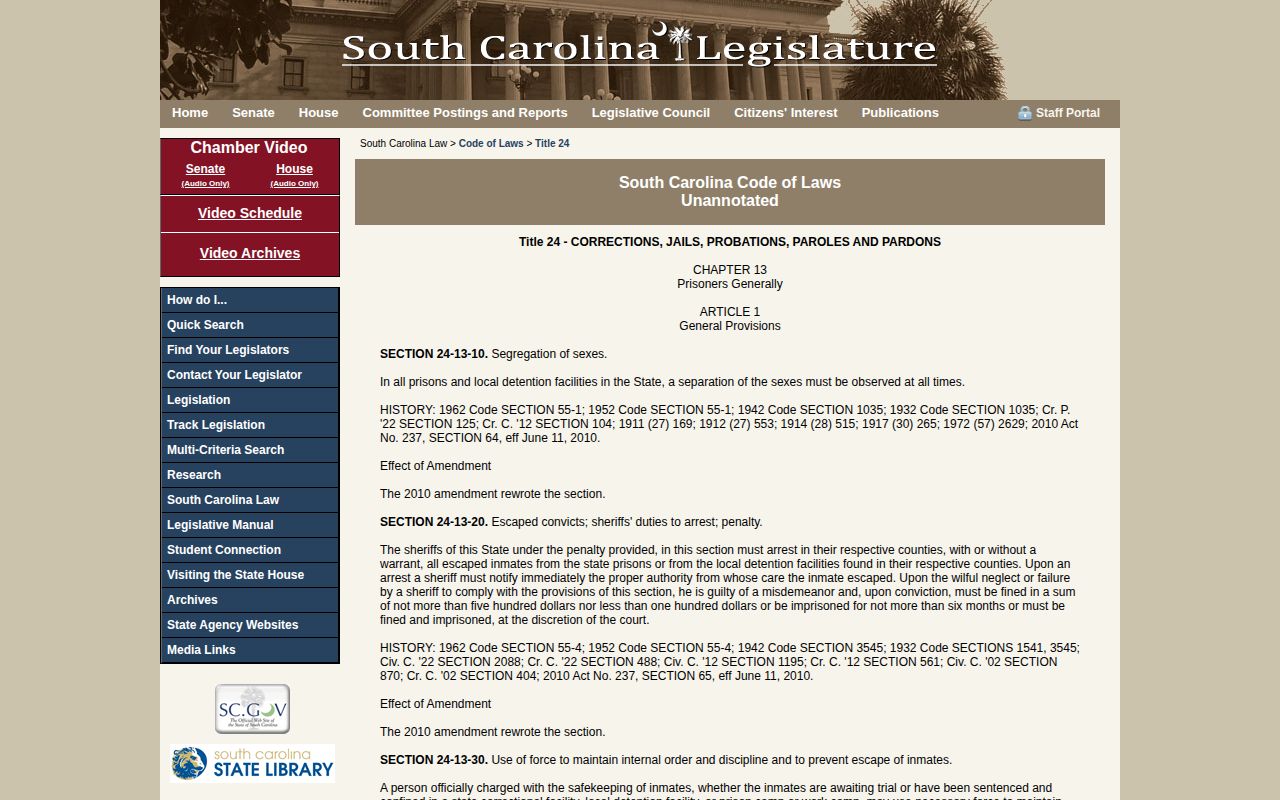
The statutory text sets the framework. SCDC or Dillon detention staff apply that framework to the actual orders and credits in one person’s record.
Dillon County Release Calculator Limits
SCDC offers a Release Date Calculator, but its own disclaimer calls the output a general guideline and the earliest possible case scenario. It assumes all possible credits. It does not account for earlier or later convictions, cannot calculate the actual date of a person who is already sentenced, and does not apply to Youthful Offender Act sentences.
The calculator is therefore a planning aid, not a person-specific record. Use the current SCDC detail for a sentenced state prisoner. The Inmate Records Office answers sentence questions at 803-896-8531. For a Dillon local sentence, use the court order, verified jail credit, and the detention center’s own computation. Mixing these routes can shift a date by far more than a simple arithmetic error.
Calculator assumptions are especially risky when terms run concurrently or consecutively. Concurrent terms run at the same time to the extent the orders provide. Consecutive terms run one after another. Prior custody credit, amended judgments, overturned convictions, and new detainers can also change the controlling term. The official record must resolve each input.
Why Dillon Release Dates Change
A projected date can move after a credit is earned, lost, or corrected. Work or education participation can affect earned credit. A disciplinary finding can cause forfeiture and push the date later. A corrected sentence start or jail-credit amount can move it in either direction. New court orders, overturned convictions, and concurrent-versus-consecutive rulings may change the term itself.
Detainers and holds affect the outcome even when the sentence date arrives. The person may leave SCDC or Dillon custody for another county, federal custody, or immigration detention rather than the community. A parole grant may create a conditional path before maxout where parole is legally available, but the hearing date and grant date are not the release timestamp.
After release, compare the projected value with the actual record. SCDC’s released search can confirm a state-prison event. Dillon detention records confirm a local booking-out or transfer. SCDPPPS can show whether community supervision followed. The Dillon County post-release supervision lookup explains how those categories differ.
- Projected date
- A changeable administrative forecast.
- Eligibility date
- A point when a release program or hearing may become available, not a promise.
- Actual release date
- The date recorded when custody physically ended or moved to another custodian.
- Discharge date
- The formal end of the applicable sentence or supervision obligation.