
Dillon Detention Release Routes
Dillon County Detention Center is the central local-custody facility for arrests handled in Dillon County. A person may leave after posting bond or receiving a recognizance release while the case remains open. Other community routes include dismissal, time served, completion of an eligible local sentence, or another court order. Each route has a different legal basis. The jail's booking-out or final movement entry is the key record of when physical custody actually ended.
Not every departure is a community release. A state sentence may send the person to the South Carolina Department of Corrections. A warrant may lead to another county or state, while a federal or immigration matter may produce a transfer to the U.S. Marshals Service or ICE. Until the destination is confirmed, the precise description is that the person left Dillon County custody. That avoids turning a roster absence into an unsupported claim of freedom.
| Departure | Best confirmation |
|---|---|
| Bond or recognizance | Jail release entry plus bond-court event |
| Time served or sentence end | Final jail movement and sentencing order |
| Transfer to SCDC | Jail movement followed by SCDC admission/location |
| Other-agency transfer | Receiving custodian and related court or warrant record |
Confirm Dillon Detention Release
No verified official Dillon County recent-release feed was found. The county sheriff page has no roster, booking, or released-person search, and the statewide jail-administrators directory describes the detention center as having no website. A commercial jail page should not be treated as the county record. Start with the official detention contact, then use the court and records channels that document different parts of the event.
- Call the Dillon County Detention Center with the full name, birth date, and booking date or number if known. Ask whether the person remains physically held.
- If custody ended, ask whether the existing record identifies a release to the community or a transfer and whether staff can state the date and time.
- Search the Dillon Public Index for bond, disposition, sentence, or later court action. A judicial order does not prove the jail completed release at that same moment.
- Request the booking sheet, booking-in/out report, final custody movement, releasing authority, actual release date and time, and receiving custodian when applicable.
- When the movement points to state custody, check SCDC. For an unresolved status change, South Carolina VINE may provide a further agency event.
A missing name is not proof of release. Transfer, spelling differences, data lag, another hold, or a restricted record can all explain an absent result.
Dillon Detention Records Contact
The official county contact is the records route for a recent status check and a historical release or movement record. Telephone staff may limit what they disclose. A limited answer does not prove release or continued custody, so use a narrow written request when the date, legal type, or destination matters.
Dillon County Detention CenterDirector Sarah Samuel
1027 Old Latta Highway
Dillon, SC 29536
843-774-1435
ssamuel@dillonsheriff.org
The backup county contact is the Dillon County Sheriff's Office, 1033 Old Latta Highway, P.O. Box 627, Dillon, SC 29536, at 843-774-1432. Its published office hours are Monday through Friday, 8:30 a.m. to 5 p.m. No local detention FOIA form or fee schedule was found, so ask for an estimate before costs are incurred.
Request Dillon Release Records
A useful South Carolina Freedom of Information Act request asks for existing documents, not an answer to whether someone is free. Identify the full name, date of birth if known, booking date range, case number, and booking number. Request the booking sheet or jail-register entry, booking-in/out report, final custody movement, actual date and time the person left county custody, release type, releasing authority, bond data, and destination or receiving custodian. Request a booking photograph separately because disclosure and reproduction issues may differ.
Section 30-4-30 sets the response framework. The initial determination is generally due within ten business days for records no more than 24 months old and twenty business days for older records. After determination and any lawful deposit, production generally follows within 30 calendar days, or 35 days for older records, unless extended in writing. Exempt information may be redacted from an otherwise public record.
The statewide county schedule item CO-18-18 describes inmate records that can include the date released, by whom and how released, bond, property receipt, and booking-in/out reports. It assigns ten years of retention after release, subject to Dillon County's confirmed controlling schedule. Record retention does not mean a web list remains visible for that period.
Dillon Detention Center Scope
Official county material describes the detention center as a division of the Sheriff's Department, with capacity for up to 200 people and 37 staff. It holds locally detained adults and, according to the county, juveniles ordered detained by courts. Public search guidance must not promise access to juvenile identity or release information. The facility may also hold people awaiting court, serving eligible local sentences, waiting for transfer, or held for another lawful authority.
The detention center is not an SCDC prison. A person sentenced to state custody can remain at the county facility while transport is arranged, but the SCDC record becomes the controlling custody source after state admission. The court decides bond, sentence, and other orders. Detention staff record the actual physical movement. Those roles are linked but not interchangeable.
- Release
- A documented end to one custodian's physical hold, which may be to the community or another authority.
- Transfer
- A movement from Dillon County custody into another agency's custody.
- Time served
- A sentence satisfied by time already spent in custody.
- Detainer
- A request or legal basis for another authority to take or continue custody.
Dillon Facility Beside Courts
The detention center sits beside the Old Latta Highway judicial complex. That close physical setting mirrors the record path but does not merge the agencies. Magistrates may set bond and issue warrants. General Sessions handles higher-level criminal matters. The detention center carries out a release or transfer after the needed authority and processing are complete.
The official SCDC institution directory supplies important context about Dillon releases:
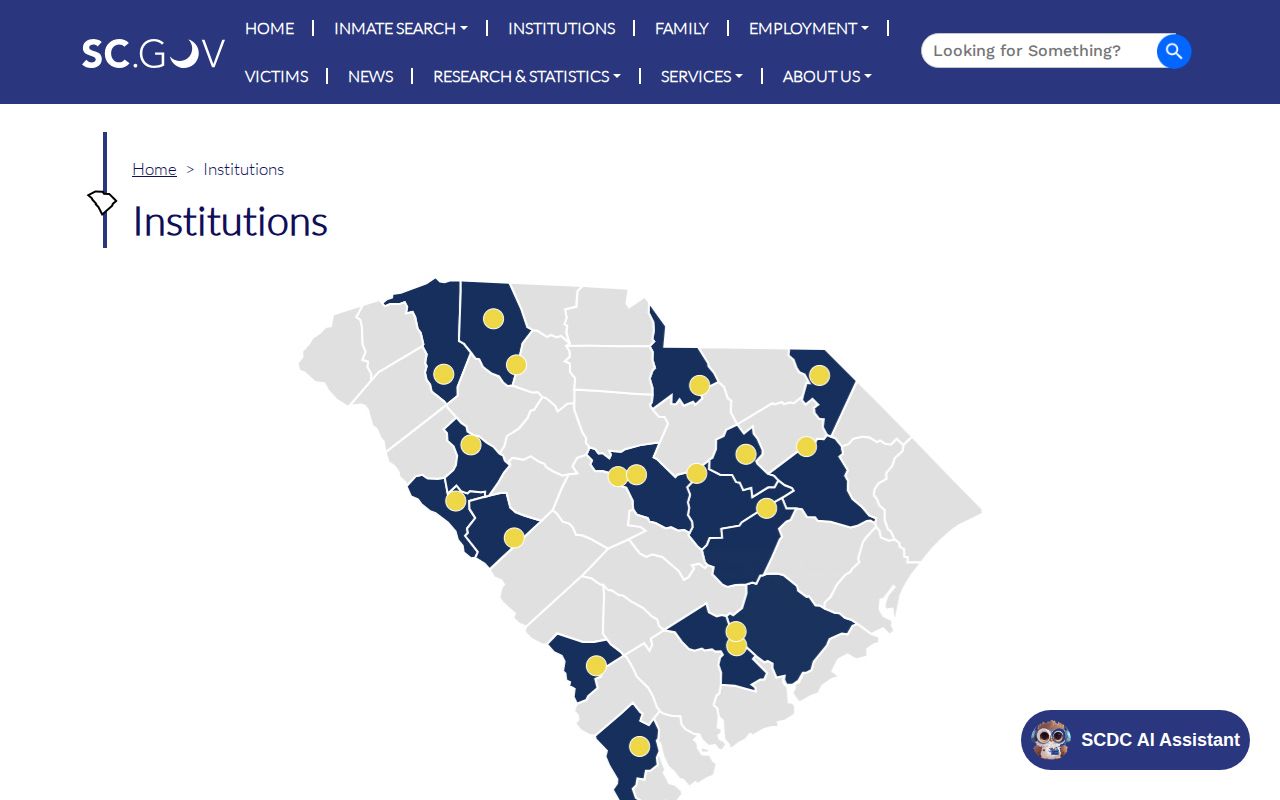
This image is an SCDC statewide directory capture, not a photograph of Dillon County Detention Center. It supports the finding that no state prison is listed in Dillon County, so a state-sentenced person may be transported to an institution elsewhere in South Carolina.
Dillon Court and Jail Records
Use the deciding court to explain why release was authorized. Dillon Magistrate or Bond Court handles applicable bond decisions and lower-level matters. Dillon Municipal Court handles applicable city cases. General Sessions in the Fourth Judicial Circuit handles felony and higher-level cases. A Public Index entry may show bond, dismissal, disposition, or sentence, yet it does not inventory every unrelated hold and may not show the exact booking-out time.
For that reason, pair the court action with the final jail record. If the court shows a bond order but the jail shows a later transfer, the person was not released to the community from Dillon custody. If the jail shows community release but the case remains pending, the release did not end the prosecution. The full Dillon County released-inmate search connects county, state, supervision, notification, and federal routes when one record alone is not enough.
Note: Call before visiting for property-pickup instructions because no official property hours, exit point, or authorized-pickup rules were published.
After Dillon Detention Release
A person released on bond may still have court dates and bond terms. Someone who completes a local sentence may have no state prison record. Another person can leave the jail for probation, state incarceration, parole-related processing, or a federal transfer. Check the exact release or transfer type before choosing the next agency.
South Carolina VINE can preserve a status-change notice from a participating agency, but it is not a certified release document. SCDPPPS covers community supervision, not every former detainee. SCDC's current search covers people presently incarcerated in state prisons, while its separate Released Inmate List covers former state prisoners. These systems should never replace the Dillon detention record for an ordinary county-jail release.