
Dillon County Parole and Probation
The South Carolina Department of Probation, Parole and Pardon Services, or SCDPPPS, manages several forms of community supervision. Parole is conditional release from incarceration before the prison term expires, when the law permits it. Probation usually follows a suspended sentence and may begin without a state-prison release. Community supervision can form the final part of a defined no-parole sentence. Supervised reentry and furlough are separate statutory programs with their own rules.
These distinctions matter in Dillon County. A person who bonded out of the Dillon County Detention Center may have no SCDPPPS record. Another person can leave an SCDC prison and remain subject to reporting, travel, treatment, or other conditions. Someone on probation may never have entered SCDC at all. The exact label in the official record should be preserved instead of calling every supervised person a parolee.
| Status | How it begins | What to verify |
|---|---|---|
| Parole | Conditional release from prison where eligible | Board action, actual SCDC release, and SCDPPPS status |
| Probation | Court-ordered supervision, often with a suspended term | Sentencing order and current SCDPPPS record |
| Community supervision | Final supervised portion of certain no-parole terms | SCDC release type and SCDPPPS category |
| Supervised reentry | Statutory transition program | Exact agency label, dates, and office |
- Discharge
- The formal end of the applicable custody or supervision term.
- Absconder
- A supervised person whom the agency reports as failing to remain in contact or comply with required reporting.
- Maxout
- The point when the applicable incarcerated term is satisfied, subject to the official sentence calculation.
- Detainer
- A request or hold that may cause another agency to receive the person instead of a community release.
Check Dillon County Supervision
The official SCDPPPS Offender Search accepts First Name, Last Name, SID number, County, and a four-digit Year of Birth. Supported combinations include last plus first, SID alone, first plus birth year, last plus birth year, county plus SID, county plus first, or county plus last. A SID is the state identification number tied to the person’s record. It is often the best way to avoid a same-name mismatch.
- Search by SID when it is known. Otherwise combine the exact name with year of birth or Dillon County.
- Open the matching result and compare the name, SID, birth year, county, and any office information shown.
- Record the status exactly. Do not convert probation, community supervision, or supervised reentry into parole.
- Compare the result with the sentencing case and, for a state-prison release, SCDC’s released record.
- Call the Dillon County office for current confirmation if the date or status affects a court, safety, or personal coordination need.
A positive match is useful evidence of active supervision. No match is not proof of discharge. The person may have completed supervision, moved to another county, entered custody again, been entered under different identity details, or never been supervised by SCDPPPS. The search is neither a county jail roster nor a complete historical archive. The broader release-record trail is available through the Dillon County released-inmate search.
Identity checks should use more than a familiar name. County, birth year, and SID help distinguish people with similar names. The county shown in a supervision result may reflect the office managing the case, not the county of arrest or conviction. A Dillon County court case can therefore be tied to supervision elsewhere, while the local office can manage a person whose original case began in another county. Preserve the exact office and category displayed.
Dillon County Supervision Office
The local office is the direct fallback when a search result is stale, unclear, or absent. Ask staff to confirm the public supervision category and the office that holds the case. Provide the name, year of birth, and SID if known. Do not ask the office to infer a jail release from a missing result. Dillon detention staff, SCDC, the court, and SCDPPPS each keep a different part of the record.
SCDPPPS Dillon County
Agent in Charge: Rhonda Elliott
Street: 200 South 5th Avenue, Gibson Building
Dillon, SC 29536
Mail: P.O. Box 1361, Dillon, SC 29536
Phone: 843-774-1026
Secondary: 843-627-7106
Fax: 843-774-4333
The official Dillon County office page also publishes dated counts by sentence category. Those figures describe the office’s workload, not a release list. On July 27, 2026, it showed 146 probation, 9 parole, 2 community supervision, 7 supervised reentry, 4 Jessie’s Law tracking, and no supervised furlough cases. The date must stay with the figures because the counts change.
The official office view shown below helps identify the correct local contact and the distinct supervision categories. View the source on the SCDPPPS Dillon County page.
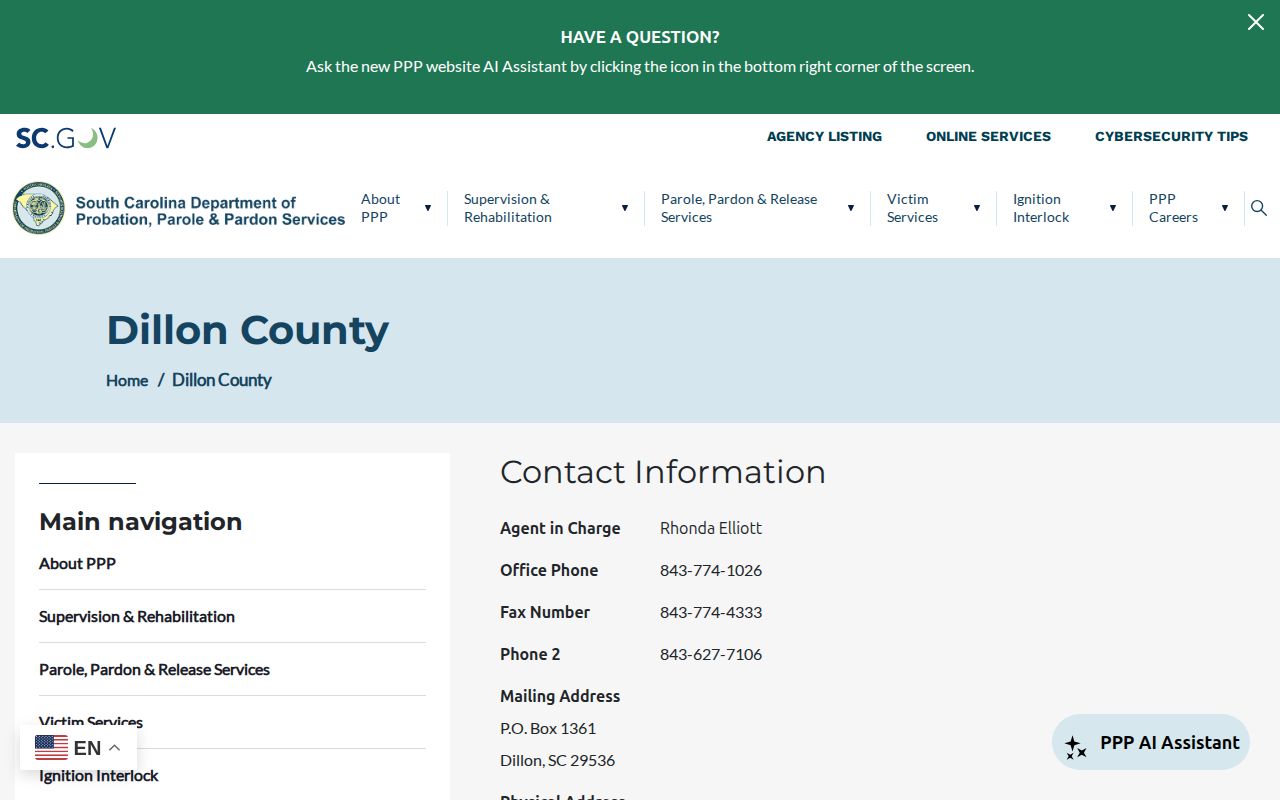
The image is a point-in-time view. Use the live office page or phone channels for a current Dillon County supervision answer.
Dillon County Parole Hearings
The South Carolina Board of Paroles and Pardons is a seven-member board associated with SCDPPPS. Its Parole, Pardon and Release Services search accepts first name, last name, SCDC number, and hearing month. A full name or SCDC number can identify one person. A name plus month, or a month alone, can narrow a near-term schedule.
Schedules are generally finalized and searchable about 30 days before the hearing. Recheck for a new date or posted action. Published outcomes can include grant, denial, continuance or deferral, and postponement of a final decision. A grant authorizes conditional release subject to processing and conditions. It does not prove that the person physically left prison that day. Confirm the actual event through SCDC’s released search, then confirm supervision through SCDPPPS.
A denial normally leaves the person imprisoned until another authorized hearing or maxout. A continuance moves the matter without deciding release. These labels should remain attached to the hearing date because later board action may change the path. Victims and other registered participants should use the board’s official information channels for the notice and participation rules that apply to a specific hearing.
Board information and hearing information explain the process. Section 24-21-610 contains a general eligibility framework, but offense dates, mandatory minimums, violent-crime rules, and statutory exclusions can control. A hearing date is an eligibility event, not a projected or actual release date.
Dillon County Supervision Changes
Conditions are the rules attached to a supervision order. Their exact terms come from the court, board, and supervising agency. A reported violation may lead to agency action, a warrant, a hearing, or a return to custody, but a public status label alone does not explain the full event. An absconder label means SCDPPPS reports a loss of required contact or compliance. It should not be treated as a new conviction.
South Carolina VINE can provide custody or supervision status-change notices for participating agencies, including SCDPPPS. It is useful for an alert, not for a certified history. A person who transfers between agencies may need a new registration tied to the new record. Court entries, SCDC movement records, and the Dillon office remain the sources for what legally changed.
Supervision ends by formal discharge, not by disappearance from a public search. Save the last official result, note its date, and request confirmation from the supervising office if a completed term must be documented. A discharge from SCDPPPS also does not erase the underlying court record. Expungement or sealing is a separate legal process.
When records conflict, compare their effective dates before assuming an error. The previous-day SCDPPPS result may lag a same-day detention event. A court order may authorize a change before the agency processes it. VINE may report a transfer from one participant without describing the next custodian. The Dillon office can confirm the community-supervision side, while the jail or SCDC confirms physical custody.
Note: Physical release, active supervision, and final discharge are three different events and may be recorded by three different custodians.
Correct Dillon County Release Records
A disputed SCDC sentence or release field has a defined correction route. Preserve the result, record the SCDC ID, identify the exact field, and note when it was viewed. The SCDC search disclaimer directs discrepancies to Ombudsman@doc.sc.gov. SCDC’s Inmate Records Office controls official sentence and release data under policy OP-21.09.
Do not try to fix a copied record on a secondary source first. The originating custodian should resolve the official data. An error in a Dillon County jail booking or final movement record belongs with the detention director or county records custodian. A wrong court entry belongs with the relevant clerk. A stale SCDPPPS status belongs with the supervising office.
A correction request should be narrow and testable. Include the stored screenshot or copy, the date viewed, the correct identity number, and the document that supports the requested change. State whether the issue is the person, supervision type, office, date, or custody status. That gives the custodian a specific field to check and preserves a clear trail if more than one agency must update its own system.
This split prevents one agency from being asked to certify another agency’s work. It also keeps parole eligibility apart from release, release apart from supervision, and supervision apart from discharge. Once the official source corrects a field, preserve the revised record and the date of correction.